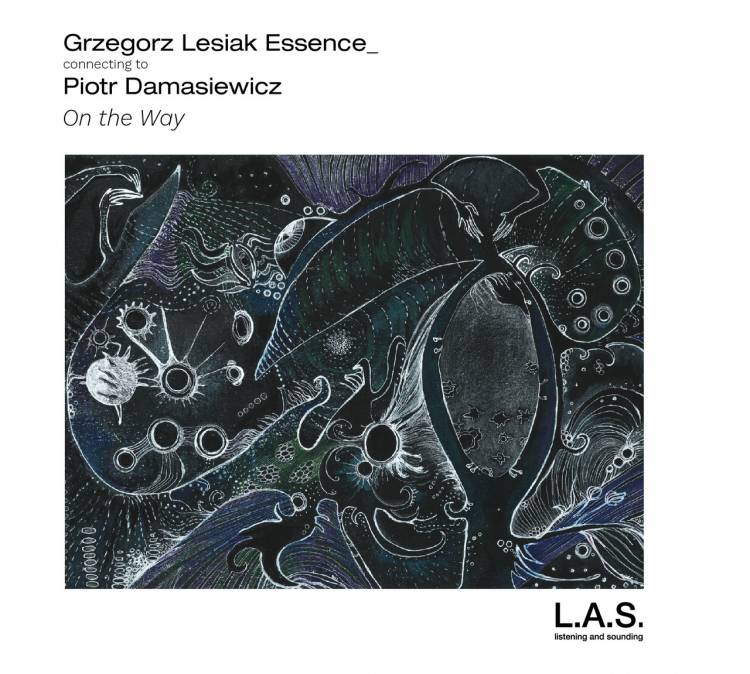
Grzegorz Lesiak Essence, Piotr Damasiewicz – On The Way (2022)
Piotr Damasiewicz — trąbka, harmonia, głos, instrumenty perkusyjne Grzegorz Lesiak — gitara Àlex Reviriego — kontrabas Vasco Trilla — perkusja i instrumenty perkusyjne
"On The Way" (2022)
Wydawnictwo: L.A.S. Listening And Sounding
Tekst: Marcin Kaleta
Gdybyż zdarzało się to częściej! "To", czyli tzw. domówka. Inaczej: koncert w domu, konkretnie w rabczańskiej willi "Wiesław" Grzegorza Wernera. 6 czerwca 2022 zagrali tam: Piotr Damasiewicz — trąbka, harmonia, głos, instrumenty perkusyjne, Grzegorz Lesiak — gitara, Àlex Reviriego — kontrabas, Vasco Trilla — perkusja i instrumenty perkusyjne. Dwóch Polaków, dwóch Katalończyków.
Zaskoczenie, że taki kwartet w takim miejscu potrafi zgromadzić ponad czterdzieści osób. Było duszno i ciasno, niektórzy pozostali więc na balkonie. Może i nie wszystkich interesował występ, na pewno nie wszyscy gustowali w jazzie czy muzyce improwizowanej, niemniej wrażenie niezwykłości udzieliło się każdemu. Dopiero co mężczyźni donośnie opowiadali niezbyt zabawne kawały, a niezrażone tym kobiety śmiały się wniebogłosy. Lecz oto pojawili się muzycy i gdy zaistnieli w "subtelnym rezonansie", na widowni nastała "zgroza nagłych cisz", by przywołać Leśmiana.
Uczestniczyliśmy bowiem w prawdziwym misterium. Medytacji. Artyści przedłożyli dźwiękowy pejzaż. Tło, zamiast wyrazistych melodii czy rytmów. Klimat. Nabożeństwo nawet. W pewnym momencie zespół zaczął... jakby się modlić. Inkantacje Damasiewicza przydały całości rytualnego charakteru. Pierwotnie materiał miał zostać opracowany bez niego, w trio pod nazwą Essence. Jednak wcześniejsza współpraca w ramach rockowo-jazzowej formacji Tatvamasi przekonała Lesiaka, by zaprosić trębacza do udziału w nowym projekcie. Tym bardziej, że go szanuje, podziwia i wreszcie dlatego, że się zaprzyjaźnili. "Dzięki niemu nasza sztuka nabrała głębszego, duchowego wymiaru".
Na początku (4-8) czerwca ubiegłego roku objawili się w czterech miastach: Kraków, Rabka-Zdrój, Rzeszów, Lublin. Opowiada lider: "Materiał, który graliśmy podczas tych koncertów, klarował się naturalnie podczas grania. Wyłaniał się samoistnie. To, co zagraliśmy w Krakowie, było punktem wyjścia, a każdy kolejny występ dodawał nowych opowieści. Utworzył się swoisty program w postaci kompozycji wyimprowizowanych. Oczywiście co innego graliśmy na każdym z tych koncertów, natomiast w drodze tworzył się w naszych głowach zarys pewnej całości, którą można nazwać formą".
Dokumentujący przedsięwzięcie album "On the Way" (2022, L.A.S. Listening and Sounding) ukazał się niespełna pół roku później. Przed zapoznaniem się nie byłem doń przekonany. Uważałem, że w tym przypadku koncert — forma quasi-teatralna — ma przewagę nad najlepszymi nawet nagraniami. Moje obawy się nie potwierdziły. Repertuar zarejestrowany podczas 7. edycji lubelskiego festiwalu "Muzyka Ucha Trzeciego" ("The Third Ear Music") zachował sugestywność. I na pewno powinien okazać się atrakcyjny nie tylko dla odbiorców obytych w dokonaniach jazzowej awangardy ostatniego ćwierćwiecza, zwłaszcza europejskiej.
Już na początku Damasiewicz deklamuje manifest własnej inicjatywy koncertowo-wydawniczej, "L.A.S. listening and sounding". Kluczowy w tym przypadku wydaje się wers piąty: "Liberty and Synergy", czyli uwolnienie i synergia. Z jednej strony zatem, jak tłumaczy Lesiak: "[…] to nie jest jazz, tylko muzyka improwizowana. Brzmi współcześnie, szeroko, wielopłaszczyznowo i wielowymiarowo". Owszem, jak najbardziej rozchodzi się tutaj "o swobodną wypowiedź własnym językiem", ale z drugiej strony również "o wyczuwanie się wzajemne, intuicję i energię. O wzajemne inspirowanie się i opowiadanie nowych wspólnych historii". To, że ich spotkania odbywają się w trybie ustawicznego nawiązywania połączenia i poszukiwania synergii, zawiera się w samej nazwie formacji: Grzegorz Lesiak Essence_ Connecting To Piotr Damasiewicz.
Poważne wyzwanie artystyczne. Niełatwo też zaprezentować taką płytę. Całość posiada dość amorficzny charakter. Bardziej aniżeli muzyką wydaje się dźwiękonaśladowczym eventem. Spontaniczne i żywiołowe, ale okiełznane i nienatarczywe to granie. Wybrzmiewa intrygująco. I nie męczy nawet przy kilkakrotnym odsłuchu. W trakcie tegoż wyławiamy smaczki. Szczątkowa melodia gitary pod koniec utworu pierwszego. Zaśpiew i okrzyki wieńczące drugi. Z kolei trzeci nabiera wyrazu za sprawą mocarnego kontrabasu, wokół którego oplatają się pozostałe instrumenty. Wreszcie czwarty, najdłuższy, podtrzymuje aurę tajemnicy, która towarzyszy nam od początku.
Program L.A.S. zrealizowano tutaj wzorowo. Przez godzinę udziela się słuchaczom przeświadczenie o uczestniczeniu we wspólnej wyprawie. Jakbyśmy odwiedzili pozaziemską katedrę, uwidocznioną w animacji Bagińskiego / Dukaja. Albo Miasto Nieśmiertelnych z opowiadania Borgesa. Albo okolice Sierra Morena, po których oprowadzał hrabia Potocki w tej najwybitniejszej spośród powieści, jakie kiedykolwiek powstały. Bądź inne, tym podobne. W ten sposób również odczytuję tytuł albumu: jako pielgrzymowanie poprzez dźwięk w rewiry, które podpowiada wyobraźnia.
Prawdopodobnie już w kwietniu Lesiak, Damasiewicz, Reviriego, Trilla oraz dodatkowo Liba Villavecchia na saksofonie altowym powiodą nas dalej. Wydana zostanie "Skawa" (2023, L.A.S. Listening and Sounding).
This is the sixth album by Polish
quartet Tatvamasi, which documents a series of music meetings held under the
slogan of the album's title, recorded over a period of couple of years by the
four members of the ensemble: guitarist Grzegorz Lesiak, saxophonist Tomasz
Piątek, bassist Łukasz Downar and drummer Krzysztof Redas and a plethora of
guests from Poland and abroad, including Avant-Garde drummers Vasco Trilla from
Spain and Peter Orins from France. The album presents seven compositions, all
uncredited and assumed to be a result of improvisations by the participating
musicians.
The music, as expected from the
underlying concept, is a series of extended improvisations, based on sketchy melodic
fragments and rhythm patterns, which characterizes Improvised Music. It
preserves to some extent the usual Jazz-Rock Fusion modus operandi of Tatvamasi
that was dominating their earlier recordings, but expands the horizons and
embraces Free Improvisation, basically letting things happen on the fly as they
develop. The three pieces recorded by a quartet, with vocalist Marta Grzywacz (and
without Piątek) are definitely the high
point of the entire album pointing to a direction
worth pursuing.
To be perfectly honest, as much
as I like Tatvamasi, this stuff just doesn't work for me as well as I expected
it would. I admit to being somewhat fed up with the Improvised Music recordings
that the Polish scene produces en mass and often without any selective process
on one hand, and the fact that throwing a group of unrelated musicians in one
room and let them play whatever comes to mind very rarely guarantees a spectacular
result on the other hand. I appreciate the will to explore and search, and the
courage to try something new, but hope this is a one time extravaganza, and the
music will return to more productive exploration in the future.
Overall this is an interesting
experiment, and as such worthy of appreciation, but the resulting music, stripped
of the circumstantial excitement, is rather pale summa summarum, with just occasional
interesting moments. Sorry guys, it's just me.
This is the fifth album by
Polish quartet Tatvamasi, led by guitarist/composer Grzegorz Lesiak, which
also includes saxophonist Tomasz Piątek, bassist Lukasz Downar and drummer
Krzysztof Redas. On this album the quartet is expanded to a septet with the
addition of violinist Anna Witkowska-Piątek, cellist Małgorzata Pietroń and
trumpeter Jan Michalec (all three participated on earlier albums of the
quartet). The album presents just four extended tracks, all composed by Lesiak.
As usual with Tatvamasi's
music, it manages to stay beyond conventional categorization, which is
obviously its strength and magic. These long expanded sonic vistas are
explorations of melodic themes, riffs, groove, beat and World Music influences,
completely intertwined within each other. The best strategy is simply to let go
of any attempt of analyzing this music intellectually and let it take you
wherever it goes by itself, trusting the musicians submissively. The music is
considerably less Avant-Garde oriented this time (except for the last piece),
with way more melodic contents, which obviously serves the group's ability to
communicate with the listener.
Whereas the previous album by
Tatvamasi ("Amor Fati") left me somewhat cold/confused, they
returned with vengeance this time producing a condensed, fully focused and
better recorded piece of superb music, which takes no prisoners. The strings
are this time completely integrated within the fabric of the group's sound and
add another important dimension. Michalec, who already appeared on two earlier
albums by the group, seems to be an integral part of the improvising tour de
force.
Overall this is an excellent
album, probably the group's best offering to date, which finds the group in top
form and takes the listener on a hypnotic and unstoppable ride through a
kaleidoscope of sounds, rhythms and melodies, which are continuously changing
and chasing one development after another and yet manage to stay focused and
coherent for the entire duration. Regardless if you are into Rock, Prog, Jazz
or Fusion, this album offers plenty of all of those and more. Hats off!
This is the fourth album by Polish ensemble Tatvamasi, which undoubtedly is one of the most fascinating and totally unpredictable ensembles on the local scene. The core quartet of the ensemble, led by guitarist/composer Grzegorz Lesiak, which also includes saxophonist Tomasz Piątek, bassist Łukasz Downar and drummer Krzysztof Redas, is expanded by a string trio: violinists Anna Witkowska and Michał Ostrowski and cellist Małgorzata Pietroń. Legendary musician/producer and Obuh label owner Wojcek Czern is also featured on electronics. The album presents six original compositions, all composed by Lesiak.
The music is, as usual, quite
beyond classification. The addition of the strings and electronics expends the
usual ingredients, such as Jazz and Rock, to include also contemporary
Classical, Folklore and Ambient elements. This time the Free Improvisation
parts are much more dominant and the music is more avant-garde oriented in
comparison to their earlier recordings, with the distinct Rocky guitar element
almost completely gone.
As already stated, the music of
Tatvamasi is completely unpredictable and every track brigs entirely different
sounds and emotions. Such diversity has of course its advantages and is very
interesting intellectually, but on the other hand lacks certain focus and
coherency and is very difficult for "conventional" listeners. In some
respects this lack of stability and jumpiness is somehow reminiscent of Frank
Zappa's approach, which of course is commendable, but might create a barrier
between the music and the audiences.
For a studio recording, the
sound quality of the album is somewhat muddy and does not allow the small,
delicate details of the music to be easily audible; perhaps purposely recorded/mixed this way, but the result is (for me) somewhat problematic. Overall this is a very
interesting album, living up to the ensemble's already established reputation,
although personally for me it is not their best work to date and I enjoyed more
their earlier recordings. Still this is definitely more ambitious than the vast
majority of albums recorded on the Polish scene and anywhere else for that
matter. I am sure they will return triumphantly again!
This is the third album by Polish ensemble Tatvamasi, led by guitarist/composer Grzegorz Lesiak. On this album the quintet lineup, which also included trumpeter Jan Michalec, saxophonist Tomasz Piątek, bassist Łukasz Downar and drummer Krzysztof Redas, was expended to a septet with the addition of Brazilian saxophonist Yedo Gibson and Spanish percussionist Vasco Trilla. The album presents just three expanded original compositions (two lasting over twelve minutes and one over sixteen minutes), all composed by Lesiak. The album was recorded shortly after the recording of their previous album a couple of years back and released only now.
The music is as unexpected as
one might expect from Tatvamasi, presenting a wonderful amalgam of Rock, Funk,
Free Jazz, Psychedelia, World, Electronic and Ambient influences. The three
tracks are extended jams, which basically provide a platform for all the
participants to play extended solos over a steady beat. Most of the solos by
brass instruments are pretty Free Jazz oriented, while the guitar playing is
more Rocky and Ambient. Several musicians solo simultaneously, conversing
between themselves and getting involved into group improvisation. The guitar
solos take the music back on track and serve as a buffer between the
multilayered Jazzy parts. As usual this music simply shuns classification. To
listeners familiar with the work of Miles Davis, this music is conceptually similar
to the Miles "electric period", which featured electric guitar as a
centerpiece of his ensembles.
It seems that this album is
more of an experimental recording of a pre-planned jam session rather than a
full-fledged new studio album by the ensemble, which is hopefully following
soon. Nevertheless it is a superb piece of music, which has very few equals in
its category in Poland
or anywhere else for that matter.
The music, being pretty
esoteric, might not be easily accessible to a wide audience and is definitely
way to open and Jazzy for the average Fusion fans, but on the other hand it
offers so much more intellectual stimuli that an effort to listen to it
open-headedly is definitely worthwhile. Wholeheartedly recommended!
This is the second album by Polish ensemble Tatvamasi, led by guitarist Grzegorz Lesiak, which also includes saxophonist Tomasz Piątek, trumpeter Jan Michalec, bassist Łukasz Downar and drummer Krzysztof Redas. The album consists of four lengthy compositions, all by Lesiak. Although not entirely unambiguous, it seems the music was recorded "live in the studio" as it includes applause, but the sound has all the characteristics of a studio recording, contrary to the statement that it was recorded during an open air concert.
Following their sensational
debut album released on the American Cuneiform label, Tatvamasi continue their
tale of success and manage to produce another piece of music, which is
fascinating and highly original. The lineup, extended to quintet with the
addition of the trumpeter, has more instrumental possibilities and skillfully
uses that advantage on this album. All members of the ensemble contribute
superb solo parts and participate in the group interplay amicably and
intelligently.
The music, as usual with
Tatvamasi, is quite beyond classification stylistically and merges many
different cross-genre elements, mostly World Music melodic lines and repetitive
chant-like progression, Rocky rhythmic patterns and Jazz improvisation.
Lesiak's guitar playing also uses electronic and ambient sound effects. The
amalgamated sound produces a trance inducing environment, which allows the
soloists to spread their wings and extrapolate into their personal dimensions. Hypnotic
and absorbing, this music is simply irresistible.
In contrast to the three
soloists, the rhythm section shows a remarkable restrain, simply driving the
music skillfully ahead, but not drawing the listener's attention away from the
centerpiece. Nevertheless their contribution is an absolutely essential piece
of the music, which would have been impossible without it. Tatvamasi successfully pass the
"second album" test with flying colors and hopefully will continue to
produce more of their unique music in the future. As usual in such cases I
can't wait to hear their next album and in the meantime I invite every
connoisseur of unusual, challenging music to get hold of a copy of this gem.
Well done!
This is the debut album by Polish quartet Tatvamasi, led by guitarist Grzegorz Lesiak, which also includes saxophonist Tomasz Piatek, bassist Lukasz Downar and drummer Krzysztof Redas. The album comprises of seven original instrumental pieces, all composed by the leader and was released by the prestigious US Cuneiform label, one of the world's leading labels specializing in new cross-genre music, with an impressive catalogue of releases. This makes Tatvamasi one of the very few young Polish groups to earn international attention already with their debut album, which is quite impressive.
Although the leader's background and personal history spin a fascinating tale, the listener should judge the music as it presents itself herein. A cross-genre creation indeed, this music escapes classification and easy categorization, which is actually quite a common phenomenon, especially among the young Polish ensembles, which surprisingly pop up on the local scene with astounding vitality and incredible talent. Tatvamasi are no different and again it's almost impossible to believe that this is a debut recording and a work of such young artists.
The music shows traces of what started many decades ago as British Jazz-Rock Fusion, amalgamating Jazzy improvisation and Rocky rhythmic patterns. Of course this music is as contemporary as it gets, standing firmly within today's music as far as the overall ambience and dynamics are concerned, paying respectful tribute to its origins. But beyond Jazz–Rock there are plenty of other influences present, often very diverse from each other, like Punk, World Music, Ambient, Minimalism and of course Free Jazz and Improvised Music. Considering the fact that this music was recorded practically live in the studio with no overdubs and other studio wizardry, what we hear is what happened, with the creative flow being captured on the fly.
The personal contributions by the four musicians are all commendable; the leader weaves some truly beautiful melody lines and memorable riffs; the saxophonists manages to float high above during his improvisations and the rhythm section keeps the often difficult music in check, driving the dynamics and leading the way securely through the many twists and turns.
The album is a breeze of fresh air and a great fun to listen to. The diversity of the pieces, which are mostly quite extensive, keep the listener on his toes at all times. There is so much happening here that several listening sessions are necessary to really "get" this music at its full bloom. Of course listeners used to improvised music will be able to appreciate this music instantly. This is a most impressive debut release, promising interesting future and establishing once more the Polish scene as one of the leading sources of new and fascinating music. Very well done indeed!